Showing posts with label Prehistoric Films From Yore. Show all posts

October 22, 2025

The Valley of Gwangi

Intro:

This is a series on old dinosaur movies. Specifically, I am looking at anything released before 1990; before Jurassic Park revolutionized cinema with its CGI animation. I will not be covering anything "dinosaur-adjacent", such as kaiju monsters like Godzilla or the creature from The Giant Behemoth, which are perhaps inspired by dinosaurs, but clearly not meant to represent any real world genus. I will also be skipping over films that are heavily dependent on "borrowed" footage from other films, such as the Valley of the Dragons / Prehistoric Valley.

Also known as:

The Valley Of The Mists

The Valley Where Time Stood Still

Gwangi's Revenge - The Valley of the Dinosaurs

Runtime:

1 hr 36 min

Background:

The Valley of Gwangi is a 1969 American film and the last dinosaur-themed movie to use stop-motion effects by Ray Harryhausen. Willis O'Brien, who was responsible for the effects in 1933's King Kong, had planned to make The Valley of Gwangi decades earlier in 1942, but the studio at the time didn't think the public had any interest in prehistoric animals. Willis O'Brien died in 1962, at which point the script rights were purchased from his widow. The plot of Gwangi was inspired by Sir Arthur Conan Doyle's book The Lost World with elements of King Kong mixed in - namely a wild animal running amok in human society. Early drafts had Gwangi fighting circus lions and getting rammed off of a cliff by a truck. Although meant to be an allosaurus, Harryhausen based Gwangi's model on the tyrannosaurus painting by Charles R. Knight, and scaled Gwangi to be within the upper limit of the largest known allosaurus and the average adult size of a tyrannosaurus.

A year was spent on the special effects, of which there were more than 300 - a record for Harryhausen. The lassoing of Gwangi was the most labor-intensive animated sequence because it required coordination of Gwangi's animation with live actors on horseback. The first animated sequence in the film was achieved with a toy horse and rider purchased from a toy store because the 40-foot (12-meter) drop was deemed too risky for a real horse. A real elephant was also planned for later in the film but one large enough to satisfy Harryhausen's requirements couldn't be found.

Filming was done in Almería and Cuenca, Spain, although directer Jim O'Connolly reportedly "didn't have his heart in it" and "lost interest in the middle of shooting". Producer Charles H. Schneer also "didn't care for the subject matter" or "the period in which it was set". Their lack of enthusiasm worried writer William Bast, who was forced to make last minute changes to the script. The lack of advertising and getting double-billed with a biker film at theaters is credited by Harryhausen as the reason for Gwangi missing its target audience. However, Gwangi has gone on to become a cult classic that is still referenced in media from time to time, including in the hugely popular Jurassic Park.

August 31, 2025

The Land That Time Forgot

Intro:

This is a series on old dinosaur movies. Specifically, I am looking at anything released before 1990; before Jurassic Park revolutionized cinema with its CGI animation. I will not be covering anything "dinosaur-adjacent", such as kaiju monsters like Godzilla or the creature from The Giant Behemoth, which are perhaps inspired by dinosaurs, but clearly not meant to represent any real world genus. I will also be skipping over films that are heavily dependent on "borrowed" footage from other films, such as the Valley of the Dragons / Prehistoric Valley.

Also known as:

Runtime:

1 hr 31 min


Background:

The Land That Time Forgot is a 1974 British-American co-production based on the 1918 novel of the same name. American International Pictures provided the bulk of the budget and filming was done at the Shepperton Studios in England. Some landscape scenes were filmed at a disused claypit in Reading, Berkshire. The prehistoric animals were hand puppets designed by Roger Dickens. Puppets were chosen over stop-motion because they had "a more fluid" movement. A small VistaVision camera was used to shoot the dinosaur background plates in conjunction with front projection effects. The U-boat and ships were models on strings or hand-held.

This was Kevin Connor's second time directing, although he had wanted to be a camera operator for horror films. According to Kevin Connor, of the three 'lost world' films he directed, The Land That Time Forgot is his favorite because it "had a good script" and while working on it he "was surrounded by great technicians". Kevin believed that there was a great future for the genre, but the powers that be felt that "children's films" had limited financial success at the box office. Regardless, Kevin found making low budget monster movies to be fun and remains proud of his work because they produced "wonderful memories of an innocent time".

Plot Summary:

During World War I, a passenger ship is sunk by a German U-boat. Two survivors, Bowen Tyler and Lisa Clayton, along with a few British officers, sneak aboard the U-boat when it surfaces, as it is their only chance for survival. Using stealth, they manage to take the German Captain von Schoenvorts hostage, thereby obtaining control of the U-boat. Tyler orders the crew to sail to a British port, but German officer Dietz sabotages the submarine's radio.

The passengers try signaling a British warship, which mistakes them for an enemy laying a trap and opens fire. The U-boat is then redirected towards a neutral American port. However, after six days of travel, Bowen deduces that Dietz has tampered with the compasses based on the direction of the sun. Captain von Schoenvorts regains control of the submarine and plans to have Bowen executed as a pirate once they convene with a German supply ship in the area. Lisa Clayton then gets into a debate with von Schoenvorts over the morality of sinking her ship, as it was carrying women and children. Although, von Schoenvorts argues that the ship was also transporting weaponry that would be used to kill women and children in his own country.

"The study of nature has taught me that life is founded upon killing and destruction. The sea swarms with living things that prey upon one another to survive." -Captain von Schoenvorts

Lisa later escapes her room and frees her people, which reclaim control of the submarine and shoot down the German supply ship. Off course and low on fuel in the South Atlantic, the group encounters an uncharted subcontinent with no beach or harbor. Schoenvorts believes the landmass to be Caprona, a place first encountered by the Italian explorer Caproni in 1721, but no one believed Caproni's claims. Fresh water and signs of green vegetation lead the group to an underground river that opens to a lush prehistoric land.

Pterodactyl soar the skies and a diplodocus is seen on land. A tylosaurus and plesiosaurus lurking in the waters attack the submarine, but are subdued and fed to the crew. Over dinner, everyone agrees to work together for mutual survival, and should they find a way to escape, will head for a neutral port.

While exploring the land they fend off an allosaurus attack and meet a neanderthal man named Ahm, who leads them to deposits of crude oil. With refining, the oil could enable escape from the island. Over the next few days a triceratops is seen defend its nest from a ceratosaurus and a styracosaurus herd passes through the area. The group gradually comes to realize that individuals on the island do not evolve through natural selection but by migrating northward across the island, undergoing a metamorphosis.

As soon as the submarine is operational again, a sudden outbreak of volcanic eruptions threatens the island. Dietz mutinies by shooting Captain von Schoenvorts and taking command of the vessel. Dietz tries escaping Caprona without Bowen and Lisa, but the U-boat cannot function in the now boiling waters and the entire crew perishes. As the only two survivors, Bowen and Lisa are forced to move northward because the local tribes will not accept them. Bowen writes a manuscript that he places in a bottle and tosses into the sea, in the hope that someone someday might know their story.

March 24, 2025

Nature Series

Nature Series: Dinosaurs is a British TV series possibly produced by the Longman Group Ltd. in 1982 and looped at the Ulster Museum and/or Dorchester Dinosaur Museum. All the North American tapes are marked as having been produced by Diamond Entertainment in 1993, but the boxes, especially the backs, resemble the ones for the "Educational Favorites" series released by Trans Atlantic Video in 1990.

 Amazon.com: Nature Series: Tyrannosaurus Rex : George Page, Nigel Cole:  Movies & TV

Nature Series: Tyrannosaurus Rex

Released 2003 to 2006 / 30 min / Diamond Entertainment

The first eight minutes are taken up by the 1930s loony toons cartoon, Daffy Duck and the Dinosaur, followed by footage of crocodiles and a narrator explaining how dinosaurs are similar to reptiles. Next they explain how dinosaurs are not similar to reptiles, the difference between carnivores and herbivores, and some true/false trivia. Several minutes of Godzilla footage with someone making silly reaction noises are followed by an educational segment on fossilization, collection and display, and theories behind the dinosaur's extinction.

It's very dry and uses a lot of old back and white footage. Some of the information is incorrect even for its time, such as using images of a Dimetrodon to demonstrate that dinosaurs could have fins, which is true, but Dimetrodon are mammal-like reptiles (Pelycosaurs) and not dinosaurs.


Dinosaurs Fun, Facts and Fantasy Volume 1 : Movies & TV - Amazon.com

Nature Series: Dinosaurs, Fun, Facts and Fantasy Volume One

?

Covers timeline, continental drift, animals like crocodiles co-existing with dinosaurs, and highlights the largest and smallest dinosaurs using 'kid-friendly' groupings: plodding (Brachiosaurus and Thecodontosaurus), bird-footed (Shantungosaurus and micropachycephalosaurus), fighting (tyrannosaurus and Compsognathus), armored (stegosaurus and Struthiosaurus), and last survivors (Triceratops and Microceratus). An educational segment recounts the story of Mary Ann Mantell finding the first Iguanodon fossils by the side of a road (this story is disputed; some believe they were purchased from quarry-men). Mary Anning finding the first ichthyosaur and the difficulties of piecing a skeleton together. Next they explain the history of the "bone wars" between Edward Drinker Cope and Othniel Charles Marsh.

This one is much more likley to hold a child's attention thanks to the use of clay-mation, puppets, color footage, cheery music, and lively demonstrations.


Nature Series Dinosaurs Fun, Facts, & Fantasy Vol. 2 (VHS, 1993)

Nature Series: Dinosaurs, Fun, Facts and Fantasy Volume Two

Released 2006 / 30 min / Diamond Entertainment

This is the second part of a two parter. Covers how dinosaurs did not walk with sprawled legs like reptiles, and the three major time periods: Triassic, Jurassic, and Cretaceous. Followed by what came after, how birds are descended from dinosaurs, and ends on a puppet show quiz.

March 17, 2025

The Crater Lake Monster

Intro:

This is a series on old dinosaur movies. Specifically, I am looking at anything released before 1990; before Jurassic Park revolutionized cinema with its CGI animation. I will not be covering anything "dinosaur-adjacent", such as kaiju monsters like Godzilla or the creature from The Giant Behemoth, which are perhaps inspired by dinosaurs, but clearly not meant to represent any real world genus. I will also be skipping over films that are heavily dependent on "borrowed" footage from other films, such as the Valley of the Dragons / Prehistoric Valley.

Also known as:

Runtime: 1 hr 25 minutes

Background:

The Crater Lake Monster is a 1977 film produced by Crown International Pictures. It was produced as a throwback to 1950s monster films and initially featured Bigfoot. This was changed to a prehistoric creature after a series of similar films featuring the hairy humanoid released around that time. According to the writers and directors, William R. Stromberg and Richard Cardella, they had a lot of problems with Crown International refusing to finance important scenes. Crown International also insisted on using sub-par music and handed editing "over to some hack" that didn't know how to use a fade or dissolve. There was also no post work done on the film, resulting in day and night scenes being just the day.

Plot Summary:

In Crater Lake, Northern California a series of cave drawings, including one of a plesiosaurus, are uncovered. Dr. Richard Calkins, his colleague Dan Turner, and his girlfriend Susan Patterson all find this discovery strange as it would imply ancient humans had seen a living plesiosaurus. A meteorite then crashes into the nearby lake which the three scientists, along with Sheriff Hanson, attempt to retrieve months later due to the meteorite being too hot to remove right away. As a result the entire lake gets warmer.

A local birdwatcher setting up equipment near the lake is killed suddenly by a plesiosaur that emerges from the water. Two friends, Arnie Chabot and Mitch Kowalski, decide to start a boat rental service. Their first customer is U.S. senator Jack Fuller, but when the boat isn't returned by the evening they discover it drifting in the middle of the lake and go out to retrieve it. To their horror it is filled with a large amount of blood, forcing them to contact the Sheriff.

A performer named Ross Conway and his wife Paula are driving to a show when their car breaks down. With repairs taking too long, the couple decides to take a boat across the lake when the monster attacks. The motor boat is faster than the plesiosaur, allowing the couple to reach land. The plesiosaur continues to pursue them on land, so the boat is set ablaze to keep the giant reptile at bay. That same day, Arnie and Mitch discover Fuller's severed head by the water, which the Sheriff collects as evidence. Realizing that the couple from earlier is probably in danger they head out to search for them. Arnie and Mitch find the charred boat along with the shaken couple, who are taken away in an ambulance.

An autopsy report comes in that states Fuller was killed by a large aquatic animal. While searching near the lake, Sheriff Hanson discovers large tracks and is attacked by the plesiosaur. He drives away to confer with Dr. Calkins and Turner, who both agree the animal is a plesiosaur. The scientists want to keep the monster alive for study while Arnie and Mitch want it for an attraction. A man named Ferguson becomes an additional victim of the monster, which starts leaving the water in search of prey. The Sheriff, Turner, Patterson, Arnie, and Mitch all head out on a bulldozer to confront the prehistoric creature. Arnie tries confronting the beast with a shotgun, but then panics and attempts to flee, getting snatched by the monster in the process. The Sheriff drives the bulldozer into the monster's neck, killing it. Arnie does not survive the encounter, leaving everyone to mourn.

Related Articles:

March 18, 2024

Journey to the Beginning of Time

Intro:

This is a series on old dinosaur movies. Specifically, I am looking at anything released before 1990; before Jurassic Park revolutionized cinema with its CGI animation. I will not be covering anything "dinosaur-adjacent", such as kaiju monsters like Godzilla or the creature from The Giant Behemoth, which are perhaps inspired by dinosaurs, but clearly not meant to represent any real world genus. I will also be skipping over films that are heavily dependent on "borrowed" footage from other films, such as the Valley of the Dragons / Prehistoric Valley.

Also known as:

Journey into prehistory

Cesta do pravěku

Runtime:

1 hr 33 min (Czech)
1 hr 24 min (North America)

Background:

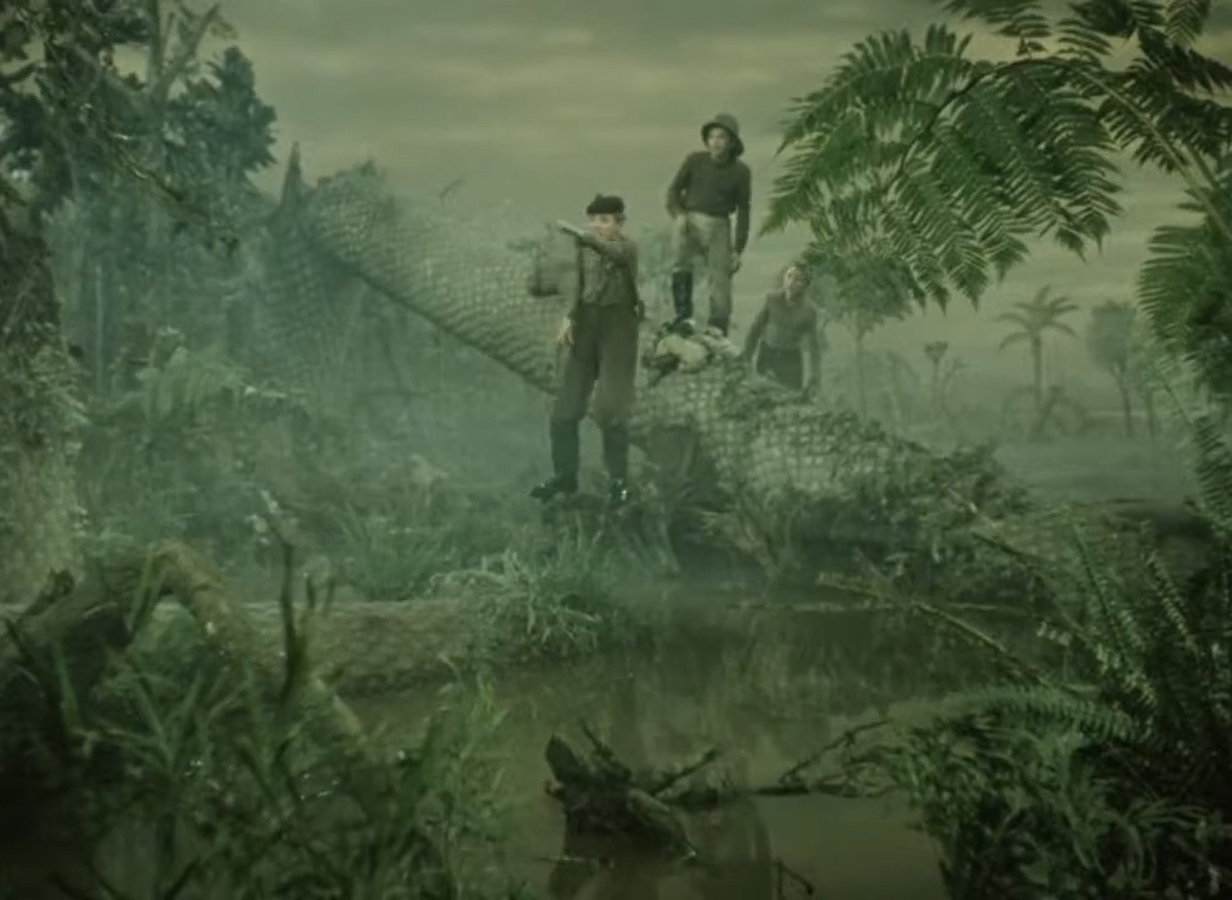
Journey to the Beginning of Time is a 1955 Czechoslovak film produced by Filmové Studio Gottwaldov. The film's imagery was heavily inspired by paleo-artist Zdeněk Burian and used full-sized models for the prehistoric animals in conjunction with 3D models that were animated in real time. 2D profiles of living animals were also used and spliced with footage of the real thing in select scenes. The movie would go on to win awards at the International Film Festivals of Venice and Mannheim. Footage was also later used in the 1961 British television series, Pathfinders to Venus.

The U.S. version replaced the opening and closing scenes with new footage of American boys visiting the American Museum of Natural History and entering the adventure through a dream sequence.

Plot Summary:

Four young boys named Peter, Toník, Jenda, and Jirka are intrigued by a trilobite fossil. Intent on finding a living one, the boys imitate the novel "A Journey to the Center of the Earth" by Jules Verne, and travel along a "river of time" in a rowboat. They pass through a cave, emerging to an ice age that forces them to drag their boat across stretches of the frozen landscape.

"He was sad he would never see one alive. Dead bones and artist's impressions just aren't the same. Jirka wanted to see them move."

They spot a living woolly mammoth along the shore and after camping for the night, follow a game trail they believed was created by the mammoth. The path leads to a cave with the remnants of ancient man's habitation. The boys are fascinated by the size of a megaceros antler and impressed by the ancient tools and wall paintings scattered about the cave - admiring the craftsmanship, artistry, and skill early man possessed. Toník tries following the caveman's trail in order to take a picture but accidentally falls into a mud-pit. Peter, Jenda, and Jirka who are watching woolly rhinoceri battle, are momentarily startled when Toník returns covered in mud.

"He hunted deer and bison, but he could also paint them like a master. We'd all seen the mammoth by the river, but none of us could have drawn it like he did. The caveman stopped being a butcher of animals for us."

They row into the tertiary period (now called the Paleogene Period and the Neogene Period) which forces the boys to remove their sweaters because of the increased temperatures. They see vultures, flamingos, gazelle, okapi, giraffe, uintatherium, deinotherium, and a saber-toothed cat. They stop to build a canopy on the boat, during which Jirka wanders off to fish. The night is spent on the boat and in the morning they flee from a jaguar.

"Science needs names, so they make them up. They always use Latin or Greek, so they can be understood all around the world. Made-up names sound okay in science, better than ordinary language. I mean it wouldn't be good if it was called "bumpy head" or "bubble nose" or whatever. "Uintatherium" sounds a lot better."

After a brief encounter with a phorusrhacos, the boys spot pteranodons flying overhead, signifying they have entered the mesozoic era. Surveying the land, they spy a herd of ornithomimids, a styracosaurus, a stegosaurus, two trachodon (now considered lambeosaurine), and a brontosaurus. The stegosaurus is attacked by a ceratosaurus, but it manages to chase off the predator with its thagomizer (tail spikes). However, the stegosaurus was wounded in the battle and in the morning, when the boys see that it hasn't moved since the previous day, they decide to investigate.

"In the past whenever people found parts from these animals, like a talon, they figured it was from some flying demon. So we have all these legends about places with dragons and basilisks, and how strong and powerful they are. We are about to enter just such a world of dragons. Not the legendary ones, the real ones, in the flesh."

While surveying the stegosaurus carcass, Jirka discovers that their boat has been destroyed by the ceratosaurus. Temporarily setback, the boys build a raft and row into the wetlands of the carboniferous era, but the thick vegetation forces the group to walk the rest of the way. Jirka wanders off to chase a meganeura, sees an orthacanthus, and protects their (now soggy) logbook from an ichthyostega. After a nights rest the boys walk into the silurian era, a time when there was no life on land, but seaweed and shells indicate life in the sea. With a little searching Jirka finds a living trilobite.

"Laying there side by side and yet so far away from each other. Between them lay 500 million years. That stone was a piece of the history of our earth."

Voyage to the Prehistoric Planet

Intro:

This is a series on old dinosaur movies. Specifically, I am looking at anything released before 1990; before Jurassic Park revolutionized cinema with its CGI animation. I will not be covering anything "dinosaur-adjacent", such as kaiju monsters like Godzilla or the creature from The Giant Behemoth, which are perhaps inspired by dinosaurs, but clearly not meant to represent any real world genus. I will also be skipping over films that are heavily dependent on "borrowed" footage from other films, such as the Valley of the Dragons / Prehistoric Valley.

Also known as:

Planeta Bur
Planet of Storms
Storm Planet

Runtime: 1 hr 18 min

Background:

Voyage to the Prehistoric Planet is a 1965 Russian film produced by The Filmgroup. This movie is basically the film Planeta Bur dubbed into English with a few new additional scenes added in. Footage from the films A Dream Come True (Mechte Navstrechu) and Battle Beyond the Sun (Nebo Zovyot) were also reused. Music and sound was 'borrowed' from Star Trek, The Outer Limits, and Dinosaurus. To further hide the fact that the film was Russian made, the U.S. version uses fake credits.

Plot Summary:

Humans are attempting the first landing and exploration of Venus when the Soviet spaceship Capella and all aboard are struck and killed by a meteor. The spaceship Astra is prepped to provide a replacement ship but it could take weeks, so the team decides to alter their plans. Dr. Marsha Evans offers to keep Vega - one of the two remaining ships, in orbit so that she may assist the remaining ship, Sirius and its crew. Sherman, Allen Kern, and a robot named John are the first to land on Venus in a small auxiliary spacecraft, losing communication with Sirius upon landing. The remaining Sirius crew consisting of Hans, Lockhart, and Andre, land next. Upon exiting the spacecraft Andre is snatched by a carnivorous alien plant and survives. The crew then take off in a hover-craft, stopping to collect a blood sample from an apatosaurus along the way.


Meanwhile, Kern and Sherman are reassembling John who had been taken apart for easier transport when ceratosaurus-esque lizard-men attack. Afterward, John helps the men traverse a ravine, but tears in their suits from the attack earlier makes both of them ill. John takes both men to a cave and administers aid. With their strength regain, both men continue their trek across the Venusian landscape. A volcanic eruption catches everyone off guard. The two men climb atop John for safety, but the added weight slows John down to where he tries to forcibly remove Kern, injuring him.

I love the robot, hover-craft, and space suit designs.

The hover-craft squad makes contact with John while traversing the Venusian Sea, but an attack from a rhamphorhynchus forces the group to submerge the vehicle. They discover a sculpture of the winged reptile with ruby eyes, indicating there are intelligent species on the planet. Back on land they rescue the two men trapped on John, leaving the now busted robot behind. With the ground becoming unstable, everyone rushes back to the Sirius spacecraft, passing by dimetrodon along the way. They quickly launch and safely return to Lunar Station 7.


Legend of Dinosaurs & Monster Birds

Intro:

This is a series on old dinosaur movies. Specifically, I am looking at anything released before 1990; before Jurassic Park revolutionized cinema with its CGI animation. I will not be covering anything "dinosaur-adjacent", such as kaiju monsters like Godzilla or the creature from The Giant Behemoth, which are perhaps inspired by dinosaurs, but clearly not meant to represent any real world genus. I will also be skipping over films that are heavily dependent on "borrowed" footage from other films, such as the Valley of the Dragons / Prehistoric Valley.

Also known as:

Legend of Dinosaurs
The Monsters of Prehistory
Earthquake 10°
God of the Sea
Giants of Prehistoric Times
The Giant Monster Bird vs. The Giant Dragon God
The Monster Birds Against the Island of the Dinosaurs

Runtime: 1 hr 34 min

Background:

Legend of Dinosaurs & Monster Birds is a 1977 Japanese film produced by Toei Company. The idea for the film reportedly came from Toei's president Shigeru Okada, who thought Japan should adopt America's film making trends after the success of Jaws. There was also increasing worldwide interest in Scotland's Loch Ness monster at the time. A 24-meter (78 foot) pool was built for water scenes and four different kinds of plesiosaurus props were created, along with life-size heads and fins. Footage of the plesiosaurus and the rhamphorhynchus was used in the final episodes of the MegaBeast Investigator Juspion series.

Legend of Dinosaurs would end up performing only modestly in Japan and was never released theatrically in the United States, although it was released as a TV movie. The film was a surprising cult hit in Soviet Russia where it was the only Japanese monster movie to see a release before the 1990s, becoming the 19th highest-grossing foreign film of all time. It is said the modern advancements of a foreign capitalist country is what caught moviegoers attention there.

Plot Summary:

In the Sea of Trees region of Mount Fuji, a barefoot woman stumbles into an icy cavern with large eggs that begin to hatch. She hysterically flees in terror and is found by a construction crew. Her story is broadcast on television, gaining the attention of geologist Takashi Ashizawa who travels to Mount Fuji to find the eggs. An earthquake knocks Takashi out and he later awakens in his father's old cabin near Saiko Lake, having been retrieved by Shohei Muku, an old friend. Takashi then meets Akiko, a former lover, and another woman named Junko.

Around Saiko Lake, rumors spread of dragons and sea monsters in the water after a young couple disappear without a trace. When Junko finds a headless horse-corpse in the road that is mysteriously moved to a tree, Takashi speculates that a living plesiosaurus is responsible. His theory proves correct when a plesiosaurus eats a prankster at the local festival.

"They told their babies to stop crying or they'd put them in the lake and the dragon with red eyes like the Chinese lantern plant would eat them up. The people of this area were very superstitious about dragons." -Singing Woman

Akiko watches the serpent devour two female divers, one of which is Junko. Meanwhile, the young rhamphorhynchus that hatched from the eggs takes flight. It terrorizes the local community before engaging with the plesiosaurus. The plesiosaurus is gaining the upper-hand when Mount Fuji erupts, sending both reptiles into a fiery chasm. Akiko almost goes with them, before Takashi grabs her hand, leaving the two of them hanging.

Dinosaurus!

Intro:

This is a series on old dinosaur movies. Specifically, I am looking at anything released before 1990; before Jurassic Park revolutionized cinema with its CGI animation. I will not be covering anything "dinosaur-adjacent", such as kaiju monsters like Godzilla or the creature from The Giant Behemoth, which are perhaps inspired by dinosaurs, but clearly not meant to represent any real world genus. I will also be skipping over films that are heavily dependent on "borrowed" footage from other films, such as the Valley of the Dragons / Prehistoric Valley.

Also known as: N/A

Runtime: 1 hr 25 min


 Background:

Dinosaurus! is a 1960 American film produced by Fairview Productions and Jack Harris Productions. A few scenes were filmed on the Island of St. Croix, in the U.S. Virgin Islands. Marcel Delgado was only given two weeks out of an agreed six, to make the dinosaur models. The stop-motion brontosaurus model and jungle set miniature would go on to appear in the "The Odyssey of Flight 33" episode of The Twilight Zone. Footage of the tyrannosaurus was also borrowed for "The Secret of Gilligan's Island" episode in season three of Gilligan's Island. It's roars were also borrowed for creatures in The Outer Limits TV series.

Plot Summary:

An American engineering team is building a harbor on a Caribbean island when they accidentally uncover two frozen dinosaurs: a brontosaurus and a tyrannosaurus. A drunken Irishman by the name of T.J. O'Leary is tasked with guarding them during the night, but a lightning strike brings both back to life. O'Leary is eaten by the tyrannosaurus who goes on to attack a trolley cart. A frozen caveman the island manager, Mike Hacker, had found and hidden also thaws out.

"How are my strapping babes? Teething are ya? Well, you're a very sweet and quiet babe not to be shrieking about it. And you too! Mustn't play favorites." -T.J. O'Leary

The caveman stumbles into a house and is confused and delighted by the objects inside. A dinosaur loving boy named Julio, comes to see "Betty" but is ecstatic to see a living caveman. Julio quickly befriends the caveman over food, but the two have to flee the house when the boy's guardian, Mike Hacker, shows up to reclaim the caveman. Julio and the caveman hitch a ride across the island on the back of the brontosaurus.

 
The caveman comes to the aid of Betty Piper who is almost devoured by the tyrannosaurus. The tyrant lizard then goes for the brontosaurus which suffers severe injuries. Eventually it manages to run away, stumbling into quicksand. Julio, Betty, and the caveman take shelter in an abandoned mine while two workers, Bart Thompson and "Dumpy", use molotov cocktails to drive the beast away from the mine. Hacker tries once last time to take the caveman hostage, but the caveman sacrifices himself holding up a collapsing beam, allowing Julio and Betty to escape.

 
The island residents, now aware of the danger, take up refuge in an old fortress. Hungry, the tyrannosaurus travels to where the food has congregated. Bart drives out in an excavator to battle the tyrant lizard, knocking it off a cliff into the water below. Tourists aboard a passing crew ship then wonder why so many people would come out to see them, but reason nothing exciting must ever happen on such a "quiet peaceful island".

"There is a time for everything. The caveman slept all those years, then one day woke like Rip Van Winkle. He found the world so changed he didn't want to be in it anymore." -Bart Thompson